(RNS) — The U.S. Holocaust Memorial Museum, one of the guardians of Holocaust memory, shot back quickly earlier this week after Minnesota Gov. Tim Walz compared children’s fears about immigration authorities in his state to Anne Frank’s desperation in her Amsterdam hideout before her arrest by the Nazis. In a post on X, the museum called the governor’s comparison “deeply offensive.”
“Anne Frank was targeted and murdered solely because she was Jewish,” the post said. “Leaders making false equivalencies to her experience for political purposes is never acceptable.”
The reaction, coming a day before International Holocaust Remembrance Day on Tuesday (Jan. 27), is the most recent flare-up in a fierce debate about the goals of Holocaust education over the past two years. Is the lesson of Holocaust a universal call to prevent genocide and protect human rights, or is it a specific call to make sure Jews are never again subject to mass murder?
The U.S. Holocaust Memorial Museum was closed Tuesday because of Sunday’s winter storm, which still grips the nation’s capital, but a spokesperson reached by email pointed to its definition of the Holocaust, which it views through the prism of antisemitism. “The Nazis targeted Jews because the Nazis were radically antisemitic,” its definition says.
This is the position of many Holocaust education centers, viewing the threats and the legacy of the Holocaust as distinct to Jews; comparisons to other groups are considered undignified and offensive.
“If people are upset about what’s happening in democracy, they can talk about authoritarianism and fascism, but making direct comparisons to the Holocaust crosses the line and we see it as Holocaust distortion, which, as I said, is seen as a threat to the legacy of the Holocaust,” said Deborah Lauter, executive director of New York’s Olga Lengyel Institute for Holocaust Studies and Human Rights. The institute has trained 7,000 public and private school teachers around the world as part of its weeklong seminars. “We don’t want to compare.”
On International Holocaust Remembrance Day, as Holocaust denial and violent antisemitism surge globally, its lessons about why our choices matter have never been more urgent. Yet the abuse and exploitation of Holocaust memory have become alarmingly commonplace. It must stop.… pic.twitter.com/xG4oFyypBr
— US Holocaust Museum (@HolocaustMuseum) January 27, 2026
RELATED: US rabbis head to Minneapolis to join protests to counter ICE raids
But other Holocaust scholars say that definition is far too narrow. They say Holocaust scholarship has evolved in the 80 years since the genocide of 6 million Jews at the hands of the Nazis, so that it is no longer seen as a unique historical experience that cannot be invoked in relation to any other event.
Omer Bartov, a professor of Holocaust and genocide studies at Brown University, said he’s “not a big fan” of Holocaust analogies but sees Walz’s comparison of immigration authorities’ tactics in Minneapolis this past month as reasonable.
“Gov. Walz, who himself has a history of having taught genocide years ago, is not off point here in warning that this must be stopped before things get much, much worse,” said Bartov. “We know from the past, including from how the Nazi regime came to power, and other fascist regimes around the world, they come with armed militias, intimidating populations, breaking the law and telling blatant lies as to what is reality and what isn’t.”
Recently, more than 700 scholars have come together to form the Genocide and Holocaust Studies Crisis Network to oppose what it calls “the weaponization of Holocaust memory.” They contest what it calls “passivity, complicity, and denial in our institutions, whether universities, museums, research centers, or scholarly associations.”
The network was formed last year in the wake of Israel’s devastating assault in Gaza and the heavy-handed quelling of U.S. campus protests.
“We think of the Holocaust as much more vast, much more encompassing of a wide variety of victims, certainly with Jews at its center, but it’s increasingly a crowded center,” said Barry Trachtenberg, a historian of modern Jewry and the Holocaust at Wake Forest University in Winston-Salem, North Carolina, who also sits on the network’s steering committee..
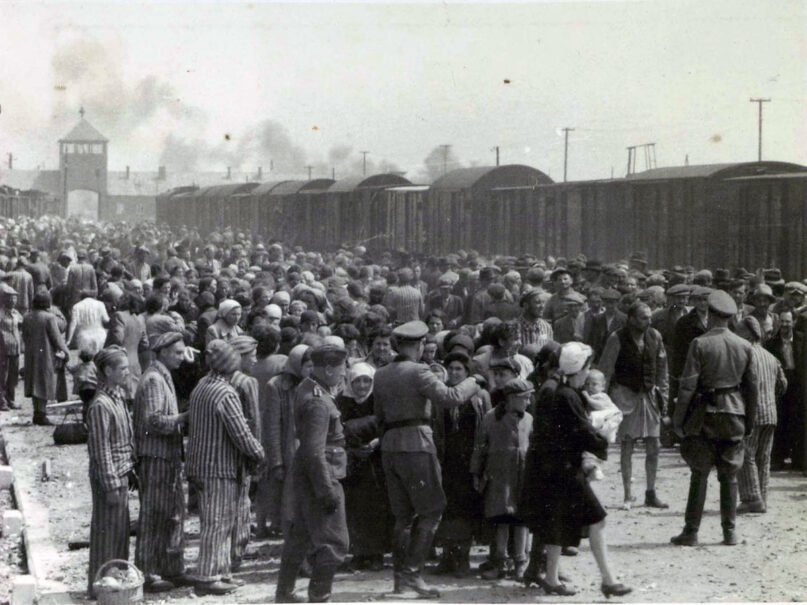
The “selection” of Hungarian Jews on the ramp at the death camp Auschwitz-II (Birkenau), in Nazi-occupied Poland, in May/June 1944. Jewish arrivals were sent either to work or to the gas chamber. (Photo from the Auschwitz Album/Creative Commons)
Trachtenberg said institutions that attempt to teach the Holocaust sometimes serve state interests, not universal ones. Last year, President Donald Trump appointed eight new members to the United States Holocaust Memorial Council, which governs the museum last year. Trump also appointed members in his first term. Scholars say the museum’s views on the debate have since narrowed.
But the Holocaust museum in D.C. isn’t the only one to squash attempts to show broader concern for genocide. The Holocaust Museum of Los Angeles deleted an Instagram message posted by one of its staffers last year that asserted, “‘Never again’ can’t only mean never again for Jews.” Another slide declared: “Jews must not let the trauma of our past silence our conscience.”
The museum explained that it deleted the post because it was “easily open to misinterpretation by some to be a political statement reflecting the ongoing situation in the Middle East.”
Ben Ratskoff, a professor who studies Holocaust and genocide studies at Occidental College in Los Angeles, suggested these museums’ positions, and that of other institutions, is incoherent.
“Why would you bring American high school or junior high students from around the country to an educational pilgrimage to the museum, if you are then going to go around and say, ‘Everything you’ve learned here is completely unavailable to you for understanding current events,’” Ratskoff said. “I mean, what is the point? It makes no sense whatsoever.”
RELATED: A language course is reviving Moroccan Jewish culture and bridging Middle East divides