WASHINGTON (RNS) — Hundreds of rabbis, cantors and other Jewish demonstrators gathered outside the headquarters of U.S. Immigration and Customs Enforcement on Wednesday (Feb. 11) to voice opposition to the agency’s role in President Donald Trump’s ongoing mass deportation effort.
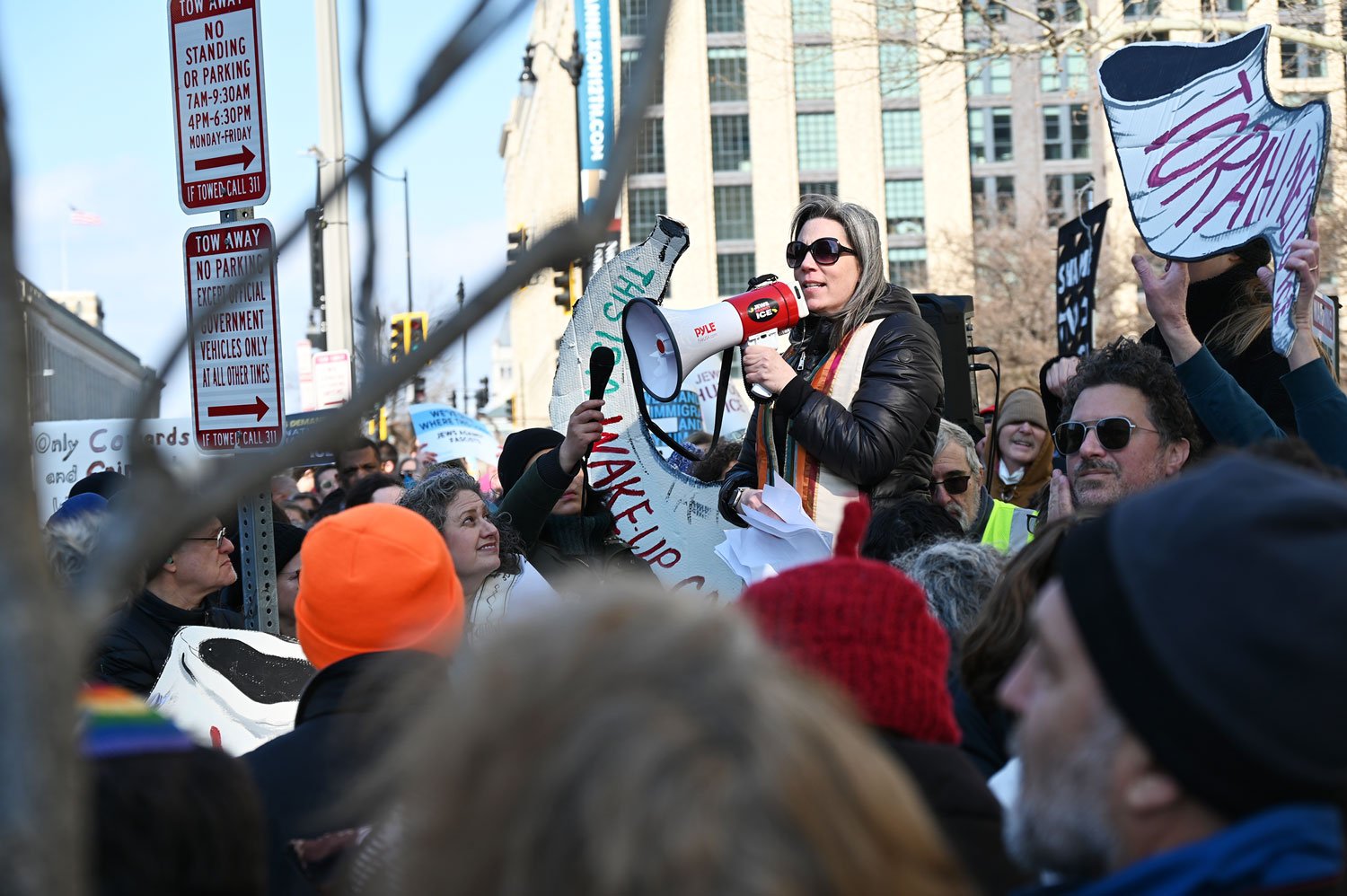
“We are watching ICE commit heinous acts of violence, of terror, and it’s designed to rid this country of the thing that makes us the strongest — which are our immigrant friends and neighbors,” Rabbi Sharon Kleinbaum said as she addressed the crowd, which stretched down the street.
Kleinbaum, rabbi emerita of Congregation Beit Simchat Torah in New York, added: “We know it from history, and we know it from God, what is demanded of us in this moment.”
The crowd then burst into a chant — “Jews against ICE” — repeating it several times over the course of the protest.
Kleinbaum’s speech kicked off a more than hourlong demonstration that expressed outrage at the actions of ICE and agents operating under the Department of Homeland Security, adding to growing faith-based resistance to the president’s immigration agenda. It also came on the heels of a three-day gathering of rabbis hosted by T’ruah: The Rabbinic Call for Human Rights, and according to protest organizers — which included T’ruah and Bend the Arc: Jewish Action, as well as more than 50 Jewish organizational sponsors — Wednesday’s event was the “largest Jewish protest against the crimes and evils committed by ICE.”

People gathered for the Jews Against ICE rally outside U.S. Immigration and Customs Enforcement headquarters on Wednesday, Feb. 11, 2026, in Washington, D.C. (RNS photo/Jack Jenkins)
Protest marshals along the edges of the crowd handed out song sheets, as well as small metal whistles that have become synonymous with resistance to the administration’s mass deportation efforts. In Minneapolis and other cities targeted by DHS, activists often blow whistles to warn others whenever they see federal agents.
Participants at the protest, which organizers said included more than 100 rabbis alone from all over the country, carried a wide range of signs. Some bore references to Scripture, such as Leviticus 24:22: “You shall have one standard for stranger and citizens alike.” Others were fashioned to resemble shofars — a traditional horn used in various Jewish ceremonies and worship — emblazoned with slogans such as “Love your neighbor” and “this shofar melts ICE.”
Rabbi Emma Kippley-Ogman, who serves as the Jewish and interfaith chaplain at Macalester College in St. Paul, Minnesota, likened whistles to shofars. She noted that the traditional horn once called people “to mutual aid.”

People gathered for the Jews Against ICE rally outside U.S. Immigration and Customs Enforcement headquarters on Wednesday, Feb. 11, 2026, in Washington, D.C. (RNS photo/Jack Jenkins)
Kippley-Ogman, who was among the roughly 100 clergy arrested in anti-ICE protests in Minnesota last month, instructed the crowd on how to use the whistles: three short bursts to indicate the presence of DHS agents, three long bursts to signal that agents are actively detaining someone.
She was followed by Rabbi Sarah Bassin, executive director of HIAS, a Jewish group that has long partnered with the federal government to resettle refugees. The group is suing the government over the president’s decision to effectively freeze the refugee program shortly after his inauguration, while allowing only exceptions for white Afrikaners from South Africa.
Bassin recited the names of 43 people she said died in ICE detention over the past year, urging the crowd to respond with “Baruch Dayan Ha’Emet” — a traditional Jewish response that means “Blessed is the judge of truth.”
Rabbi Jill Jacobs, head of T’ruah, argued that the “Jewish commitment to protecting people on the move is not new,” calling it one of Judaism’s “earliest traditions.”
“Today we are proving that we’re not going anywhere: that the Jewish community always has and always will advocate for our neighbors, our community,” Jacobs told the crowd. “When we demand ICE leave our cities, we are living our values.”
As workers exited the ICE building, participants periodically shouted, “Shame!” Some waved at ICE staffers who would occasionally peer out from windows overlooking the demonstration. A few speakers encouraged ICE agents to quit their jobs and join the protest: More than once, the crowd burst into chants, urging ICE agents to “join us.” Singing songs in English and Hebrew, the crowd belted out one song that included the pointed line, “I will not stand by when they kill my neighbors.”


The three-day convening of roughly 140 rabbis in Washington included discussion of how to oppose DHS. “A lot of the training that we did had to do with standing up against authoritarianism, and how authoritarianism has been halted in other countries,” said Rabbi Abi Weber, who leads a synagogue in Philadelphia and attended the gathering.
Rabbi Michael Rothbaum, who serves at Congregation Dor Hadash in San Diego, said he had also traveled to be a part of the convening and noted both Jewish theology and the experiences of the Jewish people compel him to advocate for immigrants. “Jewish people have been immigrants since there have been Jewish people,” Rothbaum said. “The word for Hebrew in Hebrew is Evri — it means border crosser.”
The rabbis’ conference echoed a similar a gathering that took place last month in Minneapolis, where at least 600 clergy — including around 100 rabbis —were trained on how to resist DHS.
The outpouring of religious resistance to Trump’s agenda has surprised some observers, but for Weber, the growing faith-based resistance is to be expected.
“I think so many faith traditions have this concept that we have to welcome the stranger. We have to welcome the other,” Weber said. “So I’m not surprised that at this moment, where there’s just really truly awful attacks on the rights of immigrants and refugees, we’re seeing an outpouring of support for those people from faith communities.”