(RNS) — One could argue that the first time Christians protested was the early church’s refusal to worship Roman gods and its subsequent persecution. In a story that has captured the imagination of generations of Christians, St. Lawrence, a third-century deacon, was asked to surrender the treasures of the church to imperial authorities. Three days later, he turned up with the sick, marginalized, poor, elderly and widows and boldly proclaimed, “These are the true treasures of the church.” For his insolence, he was roasted alive.
St. Lawrence’s story is a touchstone for us today of what a theology of protest might look like.
Religious leaders across the country are using the symbols, prayers, language and rituals of our traditions to resist government authority. While much of this work has been ad hoc, as individual religious leaders respond to their conscience as events unfold, we now need personal and communal theologies of protest to buttress this work.
First, protest is rooted in our deepest theological convictions. Lawrence was crystal clear that what God most values is the vulnerable and that it would be wrong to hand over his institution’s valuables to imperial authorities. In the present day, as we see dehumanization being practiced by our government, it is not enough to denounce it as wrong; our actions must be in deep alignment with the ethical commitments that our faith offers. That might look like grounding resistance in a concept like imago dei, because recognizing that we are all made in God’s image is directly linked to enforcing human dignity.
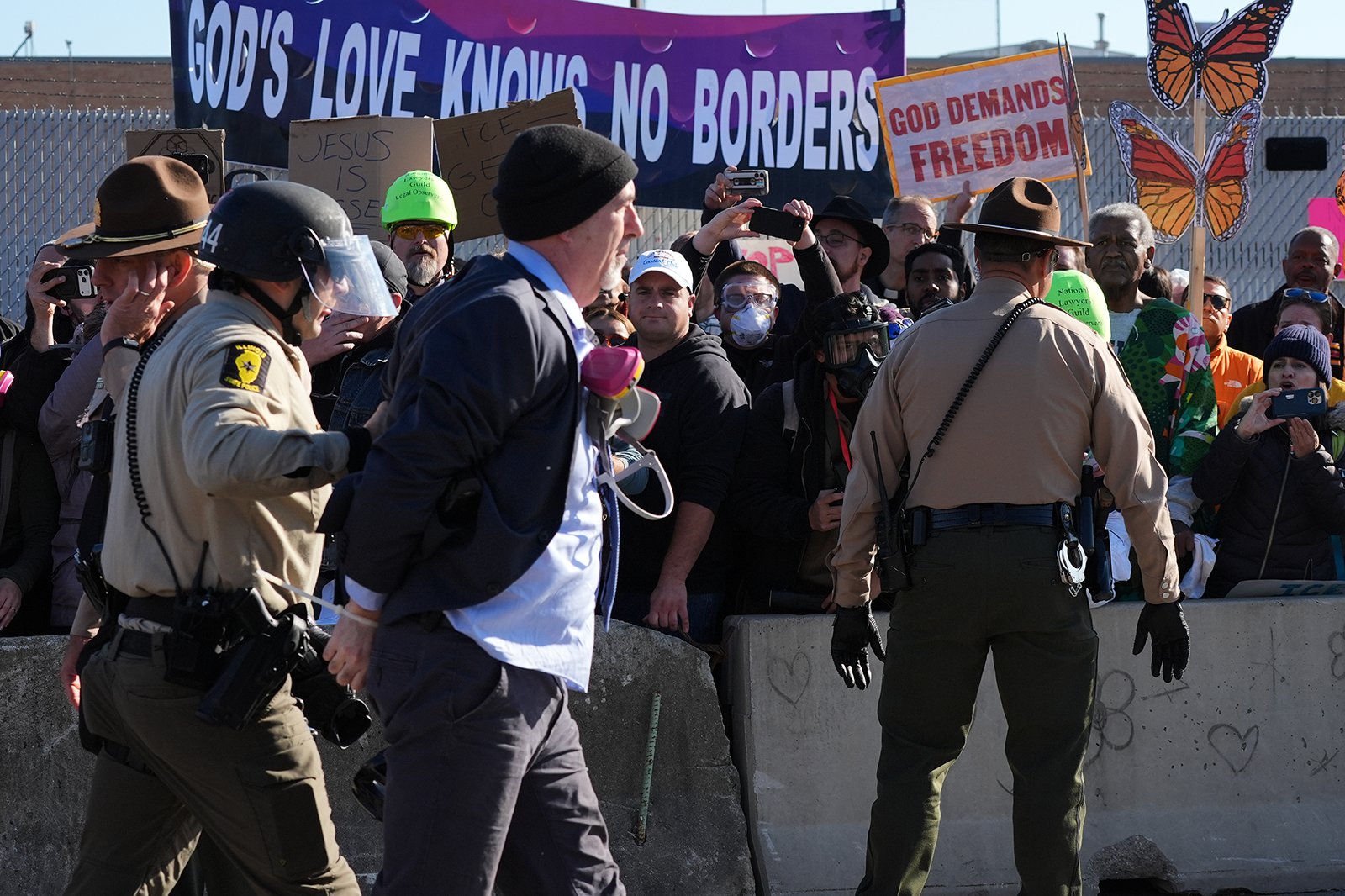
In late 2025, when I was part of the movement to shut down the Broadview ICE Detention Center outside Chicago, our prevailing concern was that those detained there were being tortured. We heard reports they lacked food, lived in unsanitary conditions, were deprived of medication and refused spiritual care, meaning religious leaders had to act.

People, including members of the Coalition for Spiritual and Public Leadership (CSPL), gather outside the U.S. Immigration and Customs Enforcement facility in Broadview, Ill., Saturday, Oct. 11, 2025. (AP Photo/Adam Gray)
We all found tools within our own traditions. Two particular protests that I found quite moving were from a local Buddhist group that held a silent meditation protest, and when a Roman Catholic group that had been praying at Broadview for decades continued their prayer service unabated, amidst a whole new group of people showing up. Both used the central practices of their traditions — meditation and prayer — to challenge dehumanization in powerful ways.
As German liberation theologian Dorothee Sölle outlined in her 1991 book “The Window of Vulnerability: A Political Spirituality”: “We have learned to use our tradition. If we do not, it will use us.” In deploying our most venerable spiritual practices in new contexts, we are simultaneously using our tradition and breathing new life back into these expressions of spirituality.
A theology of protest must also be willing to use humor, wit and irony to strike back at the imperial domination systems of our world. I can imagine with perfect clarity the smirk that must have formed on Lawrence’s lips when he presented his group of vulnerable Romans to imperial officials as the “treasures of the church.” Such fun is not a mere diversion, but it forms an important part of what it means to critique the state. There’s a reason why the Trump administration has targeted comedians and late night hosts like Jimmy Kimmel, Stephen Colbert, Seth Meyers and Jimmy Fallon.
We must also be willing to pay the cost for our actions. Lawrence paid the ultimate price for his refusal to comply; so did Renee Good and Alex Pretti, whose murders by the state were caught on video. As Herbert McCabe, the late Dominican priest and theologian, wrote in his book “Faith Within Reason”: “If you do not love, you will not be alive; if you love effectively, you will be killed.”

People visit a makeshift memorial on Jan. 31, 2026, in Minneapolis for 37-year-old Alex Pretti, who was fatally shot by federal officers. (AP Photo/Ryan Murphy)
Protests can have real ramifications even if they do not result in death. Risks to protesters’ reputation, finances or legal standing are quite real. However, the risks of inaction are also tangible. If we know something in our heart of hearts and do not act on it, we risk becoming spiritually dead. There is no way to navigate the present moment without some sort of risk, but we decide which ones we are willing to take. A robust theology of protest knows that what the state can do to you is not as scary as what silence will reduce you to.
It can seem like protest is all about a confrontation with power, but protest also functions as spiritual care. Lawrence spent his last days telling the most vulnerable people in Rome that they were the most beloved of God. When I show up to a protest with my collar on, I represent the church, an abstract idea of religion or even God in the midst of turmoil. People often find it profoundly healing that there are religious leaders who are not content to simply practice their faith in a personal way, but instead apply it to the pain in our world.
In her poem, “What They Did Yesterday Afternoon,” British writer Warsan Shire shares an evocative image of a narrator after a personal tragedy. She touches an atlas of the world, finding its pain “everywhere, everywhere, everywhere.” Protest is not just about responding to the world’s pain, but also about the personal pain of dehumanization, whether it is witnessed or experienced directly.
If we are to meet these two types of pain, religious leaders cannot only improvise acts of resistance. We must instead draw on our rich traditions to develop theologies of resistance that can sustain this work for the long-haul. That’s because when we protest dehumanization in courtrooms, on streets in front of torture sites or in town squares, we are not simply opposing the state. We are proclaiming — just like Lawrence did — what God values most, and that the truth is worth telling, even if it costs us dearly.
(The Rev. Michael Woolf is senior minister of Lake Street Church of Evanston, Illinois, and the author of “Sanctuary and Subjectivity: Thinking Theologically About Whiteness and Sanctuary Movements,” and co-author of “Confronting Islamophobia in the Church: Liturgical Tools for Justice” with his spouse, the Rev. Anna Piela. The views expressed in this commentary do not necessarily reflect those of Religion News Service.)