(RNS) — Nearly 100 faith and voting rights leaders plan to gather in Selma and Montgomery, Alabama, on Saturday (May 16) as part of a rally in protest of the recent Supreme Court decision that hollowed out a key provision of the 1965 Voting Rights Act.
The “All Roads Lead to the South” rally intends to launch a national movement to counter the ruling’s trickle-down effects on Black Americans’ political power, particularly in Southern states. Organizers expect nearly 5,000 people to attend.
The rally is in response to the April 29 court ruling, which declared Louisiana’s attempt to add a second Black-majority district on its congressional map unconstitutional — effectively gutting the landmark civil-rights era law that prohibits racial discrimination in voting. State legislatures in Tennessee and Alabama have expeditiously redrawn congressional maps in the wake of the decision.
The mobilization event, organized by Black Voters Matter, the National Coalition on Black Civic Participation and the NAACP’s Legal Defense Fund, expects 75 buses of activists from Georgia, Tennessee, Mississippi and other Southern states, with the aim to “channel national awareness, resources, and support to the state and local organizations on the frontlines,” organizers wrote in a press release.
The “No Kings” coalition, which has held three massive national demonstrations in protest of the Trump administration’s policies, plans on joining the rally, and satellite events will be held in Philadelphia; Harrisburg, Pennsylvania; and Poughkeepsie, New York.
The Rev. Bernice A. King, daughter of the Rev. Martin Luther King Jr., will be in attendance, as will the Rev. Jacqueline Lewis, senior pastor of New York’s Middle Church, and Ebonie Riley, senior vice president of the Rev. Al Sharpton’s National Action Network.
King, a lawyer and ordained minister who called the Supreme Court ruling “a shameless assault on Black political power,” said the decision could ignite a surge of mobilization among voting rights activists.
“Every attempt to silence us has only awakened a deeper resolve within us,” she wrote in an email to Religion News Service. “We are the descendants of people who turned oppression into an unstoppable, organized, righteous power.”

Tabernacle Baptist Church in Selma, Ala. (Photo by Nyttend/Wikipedia/Creative Commons)
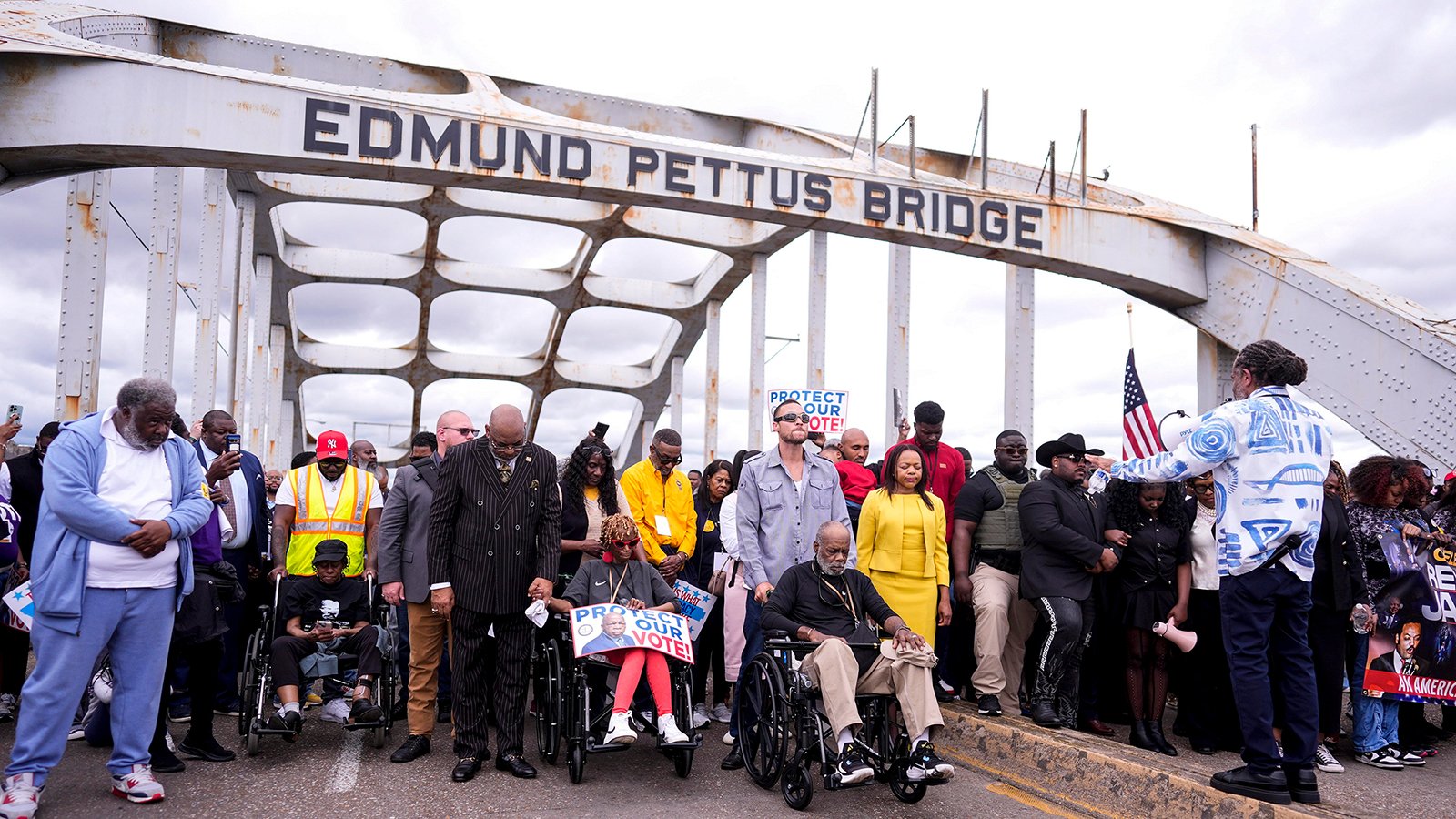
Faith leaders will first gather at Selma’s Historic Tabernacle Baptist Church for a prayer service before marching silently on the Edmund Pettus Bridge and heading to the Alabama State Capitol in Montgomery.
For the Rev. Cece Jones-Davis, a Virginia-based activist and Christian Church (Disciples of Christ) minister, starting the rally in prayer at Historic Tabernacle Church and the bridge places what she referred to as this “particular civil rights journey” within the tradition of civil rights champions who preceded it. The rally, she said, will serve to consolidate the fellowship and mobilization of faith leaders across the country on the voting rights issue.
“We grieve, but we don’t grieve as those who have no hope — no, we’re going to meet the moment and do what’s necessary,” she told RNS in an interview Thursday.
In 1963, Tabernacle Baptist Church hosted the first massive voting rights meeting, while the Edmund Pettus Bridge became the site of Bloody Sunday, when on March 7, 1965, hundreds of demonstrators, including civil rights leader and future congressman John Lewis, tried crossing the bridge before being met with a violent police response. The Rev. Martin Luther King Jr. later led 2,000 marchers across the bridge for a peaceful procession that ended in prayer to avoid confrontation with state troopers.

The U.S. Supreme Court photographed April 13, 2026, in Washington. (AP Photo/Mariam Zuhaib)
The Louisiana v. Callais Supreme Court case, in which justices ruled 6-3, with liberal justices dissenting, stemmed from a lawsuit brought before a Western Louisiana court by a group of self-described “non-African American voters” who deemed Louisiana’s decision to introduce a congressional map with two Black-majority districts “racial gerrymandering.” The map was drawn in 2024, after a ruling in a 2022 lawsuit filed by a group of Black voters, who claimed the first map crammed Black voters into a single Black-majority district, compelling the state to draw a new one.
The case, wrote Justice Samuel Alito in his majority opinion, boiled down to whether compliance with the Voting Rights Act’s second section justified intentionally considering race while drawing voting districts. The question, he wrote, had gone “long-unresolved” and had resulted in flawed interpretations of the act. “For over 30 years, the Court has simply assumed for the sake of argument that the answer is yes,” Alito wrote in his opinion.
In early May, the court fast-tracked finalizing its decision, allowing Louisiana to start redrawing a map in time for the midterm election. Justice Ketanji Brown Jackson criticized the decision, saying the court had “spawned chaos” in the state.
Though she called the decision a “real blow” to Black political power, Jones-Davis said she expects today’s movement to tap into lessons and strategies of the 1960s to overcome it.
Pastor Mike McBride, lead pastor at The Way Christian Center, a Pentecostal congregation in Berkeley, California, said gathering in Selma is a way of convening the spirits of Black faith leaders who championed civil rights. The Southern city, he said, “is the hallowed ground of our struggle.”
Before flying from Oakland to Selma on Friday evening, McBride said he will talk with his 96-year-old grandmother and 80-year-old father, who both advocated for civil rights in North Carolina, to learn from their fights and seek advice. He will also fast and pray before the rally to anchor himself in the spirit of the “Black prophetic church tradition.”
“I’ll be bathing myself in both the spirit of my ancestors and progeny,” he said.
The Rev. William D. Watley, a scholar and retired African Methodist Episcopal pastor in Atlanta, said he was in Montgomery to hear Martin Luther King Jr. speak from the Alabama state Capitol steps in 1965, after hopping on a bus from St. Louis, where he was attending college. At 79, he’s not able to return there for Saturday’s event, but he supports it.
“My own participation is one in which I support a younger generation for refusing to accept in their lifetime what my generation, and the generation before me, refused to accept in theirs,” said Watley, author of “Roots of Resistance: The Nonviolent Ethic of Martin Luther King, Jr.”
Jones-Davis said prayerful activism, like that of Black church leaders who campaigned in the 1960s, will help carry the movement.
“Prayer is what, we, as Black church people, have leaned into over and over and over again. It is a part of our tradition to act and pray,” she said. “We’re going to pray from our hearts. We’re going to pray from our history.”
Adelle M. Banks contributed to this story