(RNS) — After eliminating about 180 faith groups from its list of recognized religions, the Department of Defense moved quickly to revise the list once again on Monday (June 8) in response to criticism from various religious groups.
The most updated list dropped the word “Christian” from 19 categories after pressure from two Utah senators and others who objected to a missing “Christian” label beside the name of the Church of Jesus Christ of Latter-day Saints. The Defense Department also dropped the category “Christian-Other.”
“The Pentagon list included redundant and unnecessary labeling, and the mistake has been fixed,” the DOW Rapid Response X account tweeted, which also listed the updated religious affiliation codes.
The Defense Department under Secretary Pete Hegseth last month pared down the list of recognized religious labels in the military from 211 to a mere 31 — the vast majority of which are various Christian denominations.
On Monday, the list included 30 faiths.
Rep. Jamie Raskin, D-Md., the co-chair of the Congressional Freethought Caucus, called the revised list “completely un-American and unconstitutional,” pointing to the First Amendment, which prevents the government from establishing a national religion and allows individuals to freely practice their faith.
“Religious faith in America is not meant to be managed by the government,” Raskin said in a phone call with RNS. “It’s meant to be respected and honored by the government, but not managed, much less reduced and shrunk down.”
The narrowed list ignited as much outrage from atheists, humanists, pagans, Wiccans and druids, Unitarian Universalists, deists and a host of other new age religions excluded. Members of these minority faiths told RNS their exclusion from the new list was an affront to their sincerely held beliefs by a defense secretary who seems eager to impose his own beliefs on the military.
“When someone tries to erase, cover up, or hide the diversity present in the military, they lose out on part of what makes the military amazing,” wrote Irene Glasse, a retired Marine and a Wiccan in a Facebook post. “We are a complicated mix of people from different backgrounds, regions, cultures, perspectives, classes, races, genders, and religions. It’s a big part of what makes us so effective. Diversity is a feature, not a bug.”

Stoking the fire during a Wiccans’ Monday ritual, a pair of Wiccan soldiers are among the dozen local Wiccans who are a part of the local fellowship, June 13, 2006, in Baqubah, Iraq. (Photo by Spc. Lee Elder, 133rd Mobile Public Affairs Detachment/DVIDS/Public Domain)
The change, announced May 20 via a memo from Undersecretary of Defense Anthony J. Tata, was not publicly shared until military.com reported on it June 4. The memo said the changes should take effect within 60 days.
Sean Parnell, chief Pentagon spokesman, posted on X that the move does not reflect any official designation but rather seeks to assist chaplains providing spiritual care.
“This decrease in religious affiliation codes is not designed to make any claims on the legitimacy of any faith or religious belief, nor is it intended to provide a list of ‘officially approved’ religions,” his post reads. “The Department of War places a high value on the First Amendment and the free exercise of religion. Chaplains play an instrumental role in providing spiritual care and facilitating the Warfighters’ ability to freely exercise their religion of choice, or no religion at all.”
Members of the Church of Jesus Christ of Latter-day Saints immediately questioned why their faith was listed separately from the ones labeled as Christian.
“If only we, as Latter-day Saints, belonged to a church that had ‘Jesus Christ’ in its name and His image in its logo … Oh wait,” reads a post from Republican Sen. Mike Lee of Utah, accompanied by an image of Jesus on the church’s logo. In a video “imploring” Hegseth to change the listing, he called the change “repugnant.” He also posted that he had discussed the matter with President Donald Trump.
Later, he thanked the Defense Department for its update, saying he was “grateful to @SecWar Hegseth for correcting the error.”
Of the 30 faiths in the new recognized list, 20 are Christian denominations. The remainder include Buddhists, Jews, Baha’is, Muslims, Sikhs and people in broad categories of “no religion” or “other religions.” Among the Christian denominations, there is no distinction between various Presbyterian, Lutheran or Baptist denominations, which differ significantly on theological issues.
“There are definitely denominations here, Christian denominations, that are not listed,” said Gen. Steve Schaick, who served as Air Force chief of chaplains from 2018 to 2021, when asked by RNS about the newest list. He noted the speed with which the document has been “evolving” was highly unusual.
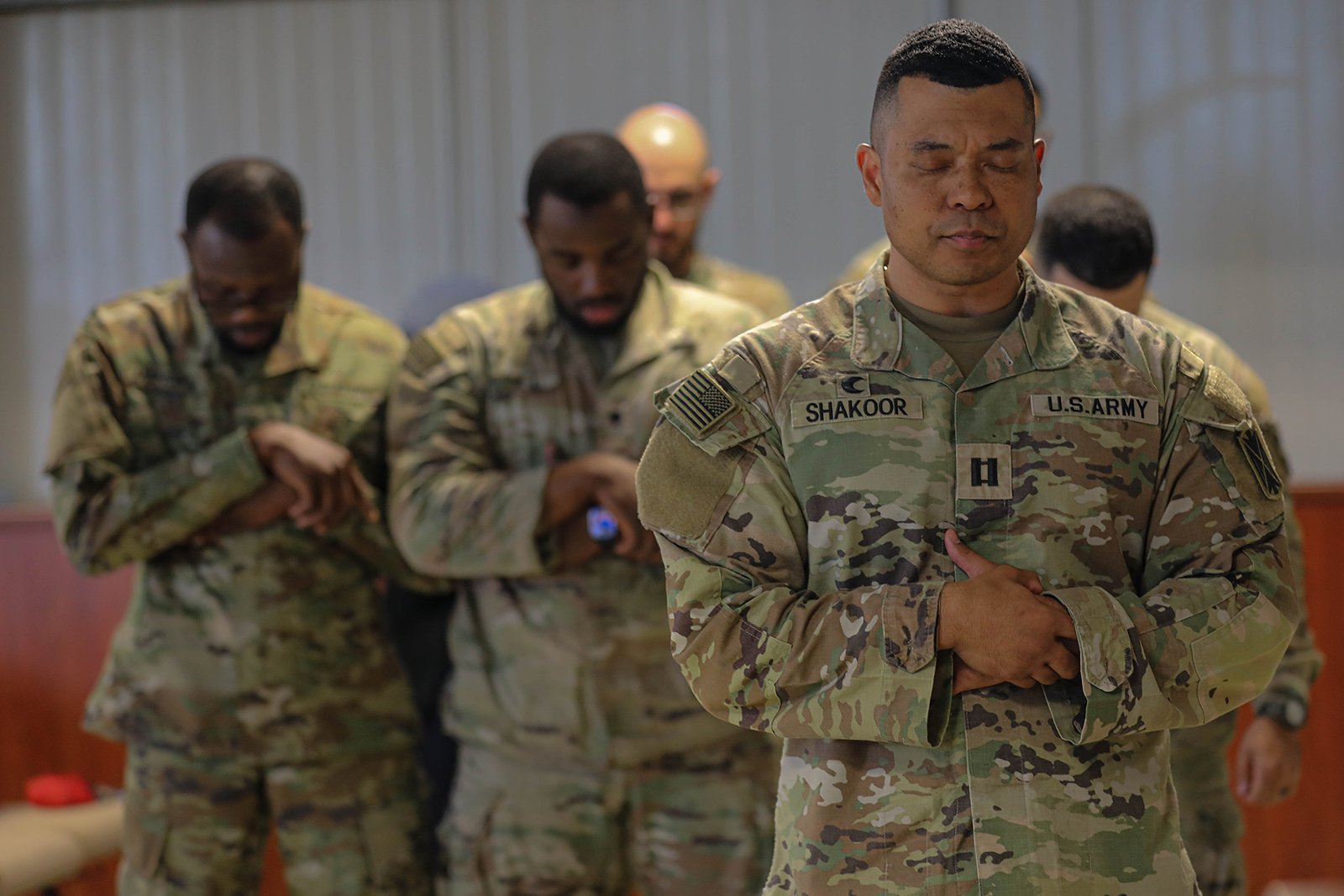
Members of Wiccan and other earth-based religions said the cuts to recognized faiths would make it far more difficult, if not impossible, for active-duty military personnel to request a day off for a religious holiday, have access to their faith’s sacred books or get permission to gather for a religious service or study. It would also make it far more difficult for military personnel to select a chaplain to provide active military personnel with pastoral care, they argued.
“A disgrace” “a deliberate rebuke” and “an insult” were among the reactions on social media and in emails from members of minority faiths who had served in the military.
In a March video, Hegseth spoke of a narrower religious affiliation list, saying it was part of the reform of the chaplain corps, which he said had been “infected by political correctness and secular humanism.”
“Faith and virtue were traded for self-help and self-care,” Hegseth said, adding that “a war fighter needs more than a coping mechanism. They need truth, big T truth. They need conviction, they need a shepherd.”
To some people of minority faiths, Hegseth’s words raised fears the military might try to convert service members to a particular brand of evangelical faith, similar to Hegseth’s own evangelical Reformed tradition.
“Pete Hegseth has no idea what a chaplain does,” said Fish Stark, executive director of the American Humanist Association. “He seems to think that they’re meant to enforce his conservative Christian views, but really a chaplain’s job is to support members of the military, or wherever they serve in spiritual care, in the context of their own religious beliefs.”
Others went further, saying the cuts to as many as 180 faith traditions was an attempt to impose Christian nationalism on the military.
“This is part and parcel of that ideology,” said Nick Fish, president of American Atheists. “There are only certain people that count as authentically American. They want everybody to fit neatly in this box, and they want those boxes to be essentially evangelical Christians, and others.”
The ranks of atheists have climbed in the military, comprising up to 2% of service members, far higher than Jews and Muslims, who make up about 0.4% each, according to a military demographic study from 2019. That study found about 70% of active-duty personnel consider themselves Christian.
On Monday, American Atheists filed a Freedom of Information Act request to the Department of Defense seeking official records on how this decision was made.
When the Department of Defense expanded its list in 2017, it more than doubled the number of religions it recognized. There were previously just over 100.
The Department of Defense did not respond to requests from RNS for additional comment.
Schaick said the new list may be a way to assist military recruits who may have found filling out an entrance form with a large array of religious choices “exceedingly difficult for a generation that cannot distinguish the term Protestant from Lutheran.”
But he added that the new approach could prevent the tracking of numbers of subgroups and affect the diversity of the chaplains corps.
Others said it was unbecoming of the government to tell service members what faiths it recognizes.
“My entire time in uniform, I wore dogtags with the word ‘Wiccan’ below my name, number, and blood type,” said Jonathan White, a retired captain from the U.S. Public Health Service Commissioned Corps.
The elimination of so many faith traditions from the list, he said, “feels like an explicit dis-invitation to so many people who have served in the military and uniformed services. It’s not an accidental omission, but a deliberate rebuke.”
(Heather Greene contributed to this report.)