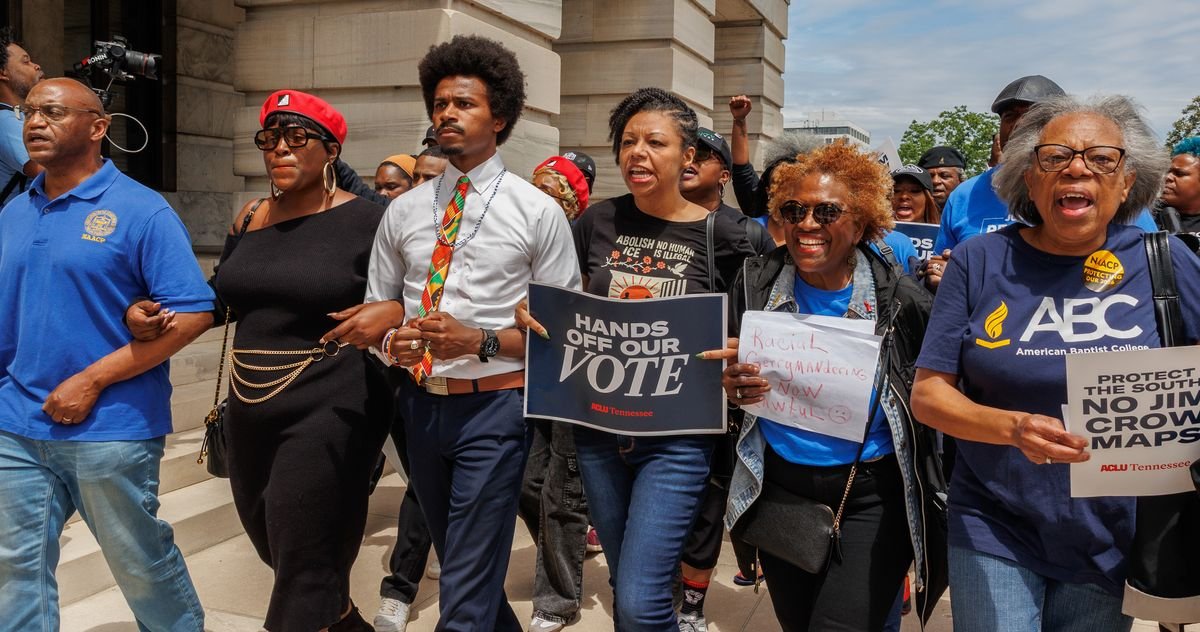

Anti-gerrymandering protesters in Tennessee.
Photo: Madison Thorn/Bloomberg/Getty Images
Republicans from Donald Trump on down are excited that the landmark Supreme Court ruling in Louisiana v. Callais has invited a wave of partisan gerrymanders in states they control. This could save GOP control of the House in November’s elections, and lead to even bigger gains over the next few election cycles. The Virginia Supreme Court’s shock decision on Friday invalidating a voter-approved retaliatory pro-Democratic gerrymander in that state has added to their excitement. But Republicans would be wise to take a beat to think about what the gerrymandering frenzy is likely to do to their efforts to shed their reputation as a lily-white party hostile to minority voters.
As recently as 2024, there was a lot of talk about the Donald Trump-led GOP bringing back a “big tent” appeal to nonwhite voters, despite the boss’s alleged lapses into racism. And indeed, Trump achieved a higher share of the Black vote (15 percent) than any Republican presidential candidate since 1960 — nearly doubling his percentage from four years earlier — despite facing a Black Democratic opponent. His percentage reached 21 percent among Black men, according to Pew’s authoritative validated voter study. It looked to some GOP optimists like the beginning of a realignment. Perhaps Democrats would no longer be able to count on Black voters as a key element of the party base, with particularly importance in battleground states ranging from Michigan and Pennsylvania to Georgia and North Carolina.
This narrative has already taken a beating thanks to Trump’s second-term record. A May 4 Economist-YouGov survey showed that just nine percent of Black Americans approve of the president’s job performance, while 8o percent disapprove (and 70 percent disapprove strongly). But the Trump-blessed state GOP assault on Black representation in Congress (and soon enough, state legislatures) that Callais has now unleashed is almost certainly going to blight the GOP brand for a long time among Black voters already deeply unhappy with the direction of the country under Republican management.
Already, with the White House urging them on, southern Republicans are taking aim at immediate extinction of majority-Black congressional districts in Louisiana, Alabama, Tennessee, South Carolina, and (possibly) Mississippi. The potential target list includes long-serving, venerable figures like South Carolina’s Jim Clyburn and Mississippi’s Bennie Thompson, whose careers date back to the civil rights movement. And other majority-Black districts will almost certainly be targeted by Republicans in 2028, 2030, and 2032 in states that couldn’t (mostly because they were too far along in the 2026 election calendar) take a hammer to them this year. The New York Times estimates that ten majority-Black congressional districts could be eliminated by gerrymanders just in the South, while one Black voting rights advocacy group claims 25 Black members of Congress (plus 191 Black state legislators) are at extreme risk once Callais has been fully implemented.
After decades of slow progress, the percentage of Black representatives in Congress and state legislatures is now roughly equivalent to the Black percentage of the population. Numbers aside, the psychological blow of reversing that progress overnight could be immense, much like the boulder rolling back down the hill in the ancient myth of Sisyphus. It would be one thing if the realignment simply replaced Black Democrats with Black Republicans. But at present, there are only five Black Republicans in Congress, as compared to 62 Black Democrats. Thanks to retirements and decisions to run for other offices, the number of Black GOP members of Congress will probably drop to one (South Carolina Senator Tim Scott) after the 2026 midterms. So decimating Black Democrats — particularly in the South — will feel to many Black Americans like a slide back towards Jim Crow. It’s especially perverse to see the Supreme Court use the 14th and 15th Amendments — Amendments enacted to give ex-slaves equal rights — to justify the bleaching of legislative bodies in a sort of counter-Reconstruction re-enthroning the South’s traditional conservative white oligarchs.
It’s no wonder the first wave in the current tide of Republican gerrymanders, in Tennessee, drew civil rights protesters to Nashville, as WTVF reported:
Hundreds of protesters gathered on the steps of the Tennessee State Capitol along Dr. Martin Luther King Jr. Boulevard on Tuesday, demanding lawmakers hear their concerns about a redistricting effort they say will silence the only majority Black district in the state. …
Martese Chisom boarded an early morning bus from Memphis to attend the rally. Chisom remembers seeing her family fight for Black voices and Black representation. …
“I just don’t understand the Republicans already have, I don’t know how many seats, but to take all the seats and leave us nothing,” Chisom said. “I’m here today to let the Republicans know, till the world knows, that we’re not going backwards.”
As lawmakers filed in, protesters chanted “shame, shame, shame.”
Black voting rights protests have also broken out in Alabama and Louisiana as legislators mull new partisan gerrymanders.
It’s a scene Republicans had better get used to if they persist in their current course. Their “big tent” is in tatters.