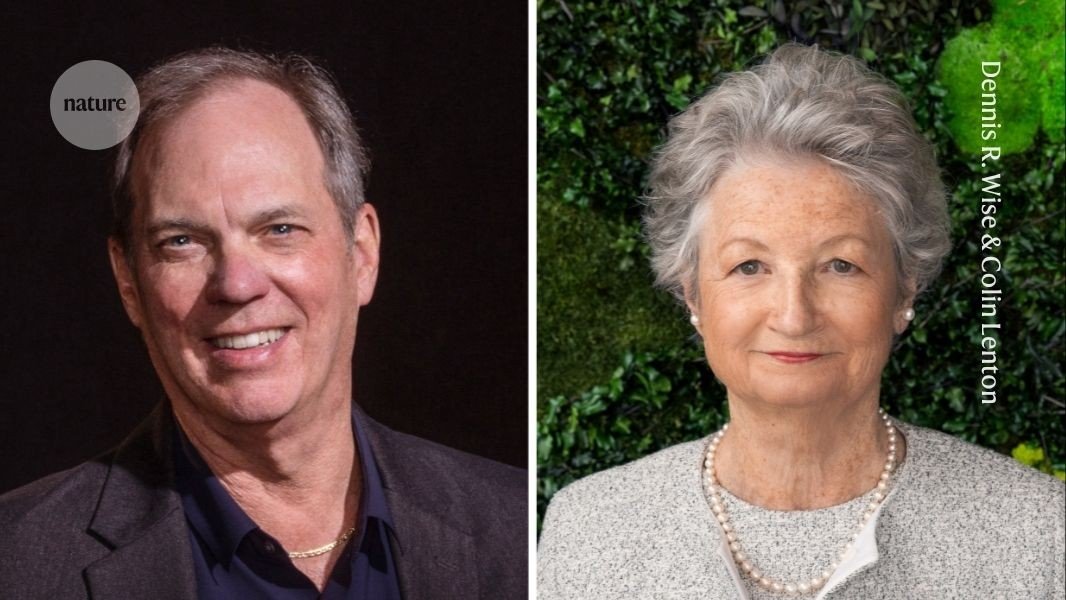

David Hertzog and Katherine High were among the winners of this year’s Breakthrough prize.Credit: Dennis R. Wise & Colin Lenton
Researchers dedicated to a decades-long quest to measure the magnetic properties of the subatomic muon particle have won one of this year’s US$3 million Breakthrough prizes. The results seemingly confirm the standard model of particle physics, but team member David Hertzog, a nuclear physicist at Fermilab in Batavia, Illinois, says that it is not yet “game over”, with mysteries remaining around why two independent methods used to calculate the model’s predictions disagree drastically. The winners of the awards, some of the most lucrative prizes in science, were announced on 18th April.

Dreams of new physics fade with latest muon magnetism result
Last year, the particle-physics and accelerator laboratory Fermilab announced the final results of its measurements of the muon’s magnetic moment, which causes the particle to wobble in a magnetic field1. This wobble, quantified by the particle’s ‘g-factor’, was pinned down to a staggering 127 parts in a billion.
“It is astonishing that human beings can measure anything to such precision,” says Tsutomu Mibe, a particle physicist at Japan’s High Energy Accelerator Research Organization (KEK) in Tsukuba. “The award is truly well deserved”.
The prize will be shared by the several hundred collaborators who were involved in the experiments at CERN, Europe’s particle-physics laboratory near Geneva, Switzerland, the Brookhaven National Laboratory in New York and Fermilab. Hertzog was “exhilarated” to learn of the win. “The delight was in some sense satisfaction that this whole team could be acknowledged,” he says.
Transformative gene therapies
Three life-science prizes were awarded for advances in gene therapies. Opthalmologists Jean Bennett and Albert Maguire, and physician Katherine High, all at the University of Pennsylvania in Philadelphia, were recognized for developing Luxturna, the first FDA-approved gene-augmenting therapy, which can treat an inherited retinal disease.
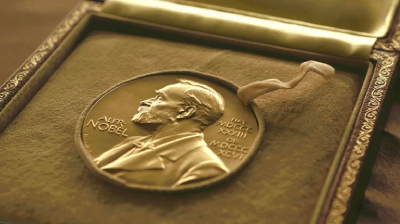
These science prizes want to rival the Nobels: how do they compare?
When light enters healthy people’s eyes, photons hit a molecule called 11-cis retinal and cause it to bend and then quickly straighten back out. But in children with two faulty copies of the RPE65 gene, the molecule stays deformed, leading to blindness in adulthood. The three researchers built on Bennett and Maguire’s initial tests in dogs and conducted a clinical trial in which a working RPE65 gene was injected into the retinas of children and adults — delivered using an adeno-associated virus2.
Before treatment, participants struggled to traverse an obstacle course and, in low light, bumped into things or wandered off entirely. But just 30 days after treatment, “they greatly improved their ability to navigate”, says High. “It happens pretty quickly.”
High learnt that she had won the prize while she was on a train, and had to stifle a scream to avoid disturbing the other passengers. She plans to donate her share of the prize to a range of charities and hospitals that work with people living in poverty.
Luxturna has been “transformative for one form of blindness that was untreatable”, says Omar Mahroo, a retinal neuroscientist at University College London, and serves as a “paradigm shift that signals hope” for future gene therapies targeting other causes of blindness.

Key muon particle physics experiments took place at the Brookhaven National Laboratory, Upton, New York.Credit: Brookhaven National Laboratory
Neurogeneticist Rosa Rademakers at the University of Antwerp in Belgium and neurologist Bryan Traynor at the US National Institute of Aging in Bethesda, Maryland, shared a prize for independently discovering that an inherited form of frontotemporal dementia (FTD)3 and motor neuron disease (amyotrophic lateral sclerosis) are caused by a common mutation in the C9ORF72 gene.
Rademakers, who describes the win as “unexpected” and “surreal”, discovered the connection while examining tissue samples from people with a particular type of FTD and realizing that members of their families had motor neuron disease4.