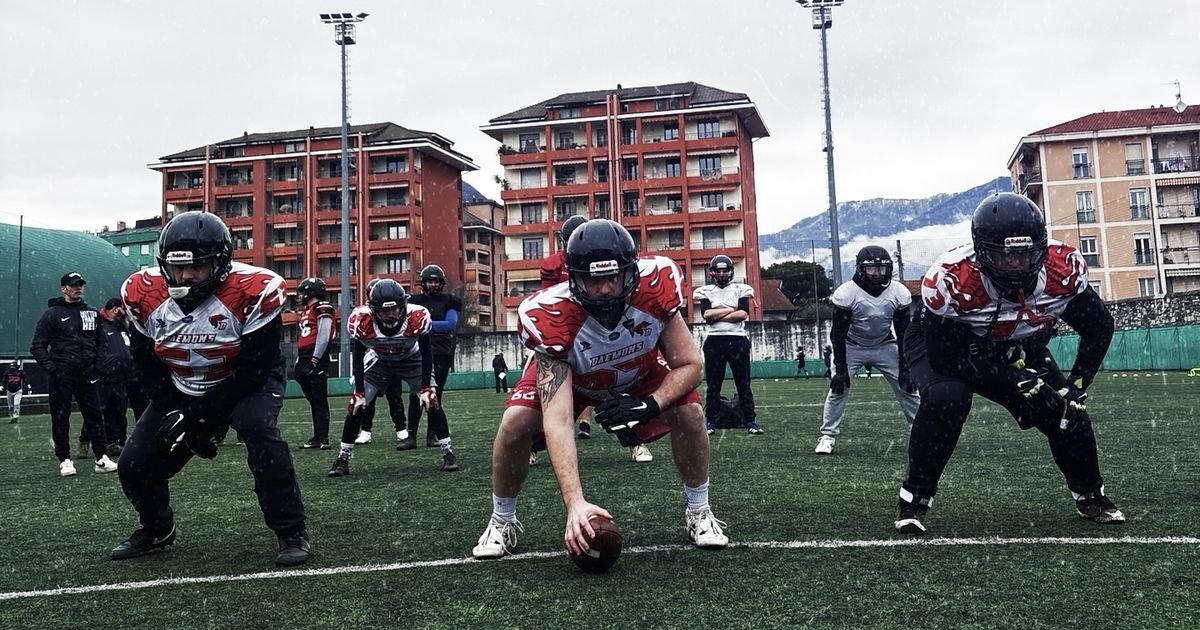

Photo: Instagram/daemonsaft
Most football offensive coordinators rise early on game day but not as early as Max Campbell, who is up hours before sunrise. That’s not because of nerves, adrenaline, or anything related to football’s grind-set mentality. It’s because Campbell’s games actually kick off at daybreak — at least where he’s coaching from. His team, the Daemons of Monza, plays in Italy, but Campbell, who is 24 years old, calls offensive plays from a conference room nine time zones away in his hometown of Eugene, Oregon. In a field that does not lend itself naturally to remote work, Campbell appears to be the world’s first fully WFH football coach. (A disclaimer: Campbell is my stepnephew; I see him once a year or so at family gatherings.)
“I like doing it with gold through the single,” Campbell says in heavy football jargon to his Italian quarterback, who is between drives on the other side of the world and also on Campbell’s TV. “What do you think about that? Like trips right, gold 27, you either take your shot to the whip or a comeback.”
When remote-work culture meets the world of football, there’s no place for barking dogs, household chores, or weak coffee-shop Wi-Fi. So on game day, Campbell turns the conference room at his office day job into an offensive-coordinator’s booth. The game plays on the TV, screen-mirrored from Campbell’s laptop. An opponent scouting report sits taped on the long table, and pens and legal pads are scattered around, useful for throwing in frustration. Campbell clutches his call sheet as he conducts a four-hour speakerphone WhatsApp call to Matteo Piccoli, his co–offensive coordinator on the field in Italy, who wears a coach’s headset on one ear and holds his phone to the other. When the team’s defense takes over, the phone gets passed around the sideline to Campbell’s quarterback and offensive teammates. During the week, Campbell sends his players and fellow coaches video cut-ups and notes from a football-playbook app called Hudl, all in a Google Drive folder. He texts with each player individually after analyzing video footage from practices with humorous instructions embedded to be sure they read his messages (“Text Coach Max your celebrity crush”).
It all sounds radical for a sport rooted in tradition. But football is a results business, and Campbell is getting them.The Daemons are in first place in their division at 7-0, averaging 29 points per game. They earned a first-round bye in the upcoming playoffs and are headed directly to the semifinals.


From left: Photo: courtesy of the subjectPhoto: courtesy of the subject
From top: Photo: courtesy of the subjectPhoto: courtesy of the subject
The absence of a coach yelling, lecturing, motivating, and chewing out his players in person seems unthinkable. Yet witnessing Campbell’s system in action, which he devised, feels like a glimpse of the future, one it’s hard to imagine anyone over 30 coming up with. NFL and NCAA rules indirectly ban remote coaching via their policies on electronic devices: The leagues don’t allow phones or Apple watches on the sidelines to prevent outside information trickling in, whether from spies or AI. The NFL works to ensure no outside line can reach a coach’s headset and controls the tablets you see on the sidelines (which are locked down and collected right after the final whistle). But such regulations might not last forever. After all, rule changes in major sports often crop up first in minor leagues (the pitch clock and ABS in baseball), rival leagues (the ABA’s slam dunks and three-point lines), and far-flung leagues (offside laws, additional substitutions, and various technology in soccer). Maybe football is next, and maybe Italy is a proving ground.
Campbell’s journey to remote football coaching has a Gladwellian flavor to it: He’s an affable cast-off from an entrenched, self-selecting system who took a fresh look at things. Campbell began college as a Division III backup quarterback at Linfield University, and slowly accepted he’d never be a starter. In 2022, he was recruited by a former mentor to be the assistant quarterbacks coach at the University of Nevada, Reno. It was an unusual move but a rare opportunity; coaching was his career goal anyway, and prowling the sidelines at powerhouse college-football stadiums fulfilled him. There were also significant downsides. Workdays were 16 hours long, and Campbell wasn’t given time to attend the classes he enrolled in, never mind friends or anything outside football. The team lost most of its games, and Campbell would overhear senior coaches confess that they hadn’t seen their wives or kids awake for weeks at a time. At the end of his second season, he got a firsthand taste of the business side of college football when he and the entire coaching staff were fired.
“I’d never seen grown men with kids and a new mortgage get told that the last paycheck they’ll get was the one they got three weeks ago,” Campbell explained. “It was a wake-up call.”
He graduated from college and got a job in property management in Eugene. Coaching football for fun at his old high school made him fall back in love with the game. Several months later, he received a cryptic and well-timed text: “hi, want to coach in Italy?” A team near Milan, the Daemons, intended to make a push for the first division, but they’d just gone 1-8 and were looking for American expertise for their offense; a mutual contact from one of football’s intricate coaching trees had recommended Campbell.
American football has been played in Italy for more than 40 years and consists of several divisions, like soccer, with promotion and relegation; Americans are allowed to play in the top division, while players in the second division on down are Italian only. American coaches at the start or end of their careers have been drawn to European football for years, and Campbell would soon learn why.
In 2025, he put his day job on hold for seven months to live in Italy and try his luck. His team improved to 6-3 — and he had an amazing time.
“Something really stuck with me about American football in Europe,” Campbell says. “It’s beautifully chaotic but so simple to the core of football because it’s a bunch of guys doing it for the love of the game. All the politics in high-level football in America are completely not there.”
Campbell thought that was the end of what he considered a sort of gap year, and he settled back into his day job. But the Daemons’ owner wanted Campbell back in 2026. As Campbell considered it, he recalled the story of Matt Lubick, an offensive coordinator who succeeded Campbell’s boss at University of Nevada. For a brief period several years ago, Lubick worked as an analyst for the University of Kansas remotely while he recovered from cancer treatment at his home in Colorado. Campbell always remembered how cool that arrangement sounded — minus the diagnosis — and he was already Zooming with his Italian quarterback in the offseason for fun, going over game film. Lubick didn’t have any game-day responsibilities during his WFH stint, but if he had found a way to do anything remotely at the Division I level, maybe Campbell could go one step beyond in Italian football. He proposed his remote-work communications system, and Daemons owner James Dewar was onboard. Campbell traveled to Italy in January for preseason training and to test his setup. So far, it’s working well, especially considering how much faith it requires in Italian infrastructure. (Twice the TV signal has lagged and Campbell found himself one or two plays behind the live action.)
Campbell says that while practices are vastly more difficult without him being there in person, working remotely on game day has its advantages. It provides the same lack of distractions on the sidelines that in-person offensive coordinators seek when they call plays from upper-level booths, which is common in the NFL. “It takes the emotion out of it and is a calm, quiet atmosphere to make calculated calls and focus on the game plan,” Campbell says. “That’s the exact same feeling I experienced when I was in the box in college. I think it’s making me a better play-caller than when I was on the field in person.”
As is true of many remote workers, Campbell has tested the boundaries a little. At the end of a recent weeklong trip to Mexico with friends, they all decided to stay longer — but that meant finding a place to coach his game that Sunday. Campbell called plays from a table at the Puerto Vallarta airport’s Bubba Gump Shrimp Co. as classic rock blasted from the speakers. Campbell’s buddies cheered him on as locals understandably shook their heads at the American yelling into his laptop. He then had to rush down the jetway as his team ran out the clock for the win.
Remote coaching has become a way to keep football in his life without it becoming oppressive. Campbell found that elusive work-life balance that WFH culture promises, except that football isn’t officially work anymore — it’s more of a hobby. That may be key to the whole enterprise.
There is an ingrained workaholism in football, but Campbell’s arrangement seemed enticing to everyone I spoke to in the football world. So could it ever actually happen at the highest levels? Turns out it almost did; Lubick, Campbell’s inspiration, came close. During his recovery from cancer, Lubick’s head coach at Nevada, Jeff Choate, proposed that he be the offensive coordinator there.
“I thought [Choate] was joking, but he said, ‘We can figure out a way you can call plays from your bedroom,’” Lubick told me. “It got me thinking, If you had a physical thing that kept you from being somewhere, could you work around it? We were actually going to attempt it, but then I got cleared to be there in person.”
Lubick’s remote experience stuck with him. “One of these days, I’ll slow down and retire,” he says. “To me and a lot of coaches, this would be the perfect segue job: I can live wherever I want and still be able to be involved with football as a remote coach. If you hear of more people doing this, please send me feedback. I’d love to know how they’re doing it.”